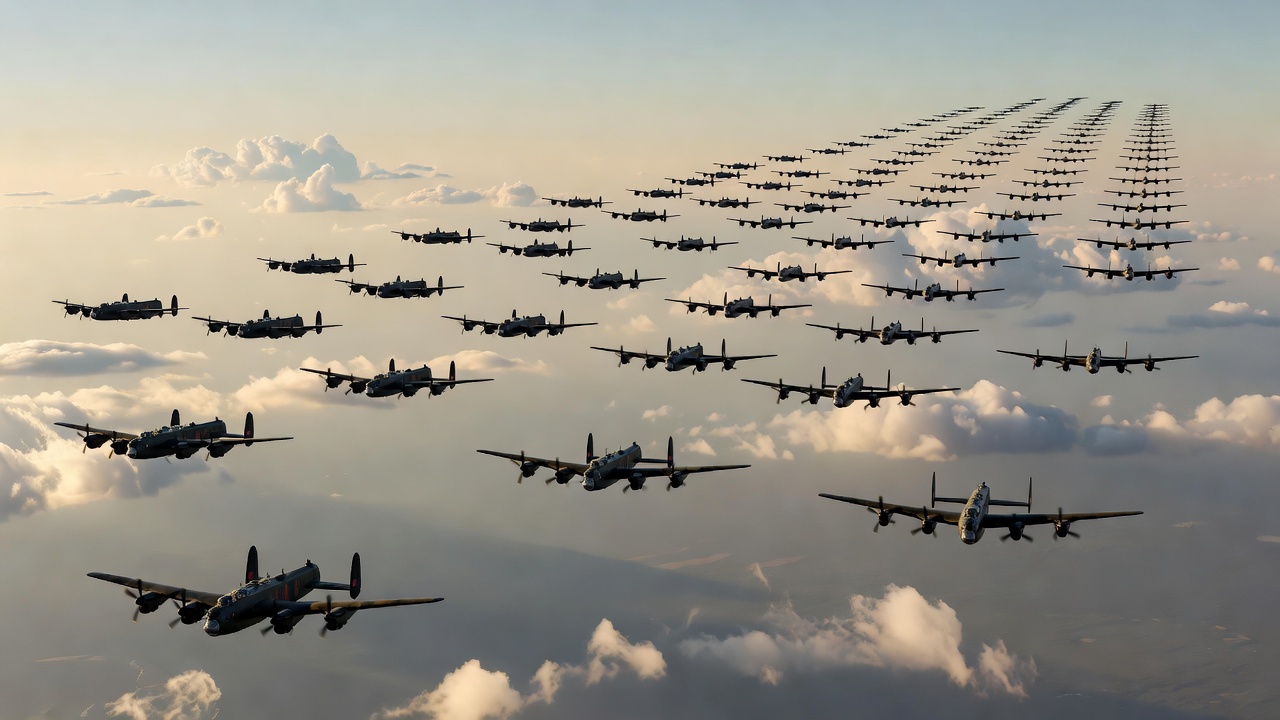
The Avro Lancaster was the most successful British heavy bomber of the Second World War. It emerged from the failure of its predecessor, the twin-engine Avro Manchester, which was plagued by the unreliability of its Rolls-Royce Vulture engines. By expanding the wing center section and installing four proven Rolls-Royce Merlin engines, chief designer Roy Chadwick created an aircraft of legendary capability.
Payload and the Bomb Bay
The defining feature of the Lancaster was its massive, unobstructed bomb bay, which ran for 33 feet along the bottom of the fuselage. Unlike American bombers such as the B-17, which had structural bulkheads interrupting their bomb bays, the Lancaster's uninterrupted space allowed it to carry uniquely large ordnance.
Standard operations saw it carrying a mix of high explosives (like the 4,000 lb "Cookie" blockbusters) and thousands of smaller incendiary bombs. As the war progressed, modifications allowed the Lancaster to carry Barnes Wallis's specialized weapons, including the 12,000 lb "Tallboy" and the monumental 22,000 lb "Grand Slam" earthquake bombs, which were used to destroy hardened targets like U-boat pens and viaducts.
Defensive Capabilities
Operating primarily at night under RAF Bomber Command's area bombing doctrine, the Lancaster relied on darkness for defense rather than heavy armor and armaments. Its defensive array consisted of powered turrets:
- Nose turret with two .303 Browning machine guns.
- Mid-upper turret with two .303s.
- Tail turret housing four .303s.
This armament was relatively light compared to USAAF daylight bombers. The .303 caliber weapons often lacked the stopping power and range to effectively deter heavily armored German night fighters equipped with 20mm or 30mm cannons. A crucial tactic for survival was the "corkscrew" maneuver—a violent, diving turn used by pilots to throw off enemy aiming and radar tracking.
Operational History and Legacy
The Lancaster entered service in early 1942 and quickly became the mainstay of the strategic offensive over Germany. It is perhaps most famous for Operation Chastise in May 1943, where specialized Lancasters of 617 Squadron dropped Barnes Wallis's "Upkeep" bouncing bombs on the dams of the Ruhr Valley.
The human cost of Bomber Command's campaign was staggering; nearly half of all aircrew were killed in action. The Lancaster itself was a complex machine to escape from in an emergency, resulting in lower crew survival rates compared to other bombers when shot down.
Nevertheless, the aircraft's efficiency, payload capacity, and rugged construction made it an indispensable asset to the Allied war effort. It remains a somber and powerful symbol of the immense industrial and human resources committed to the air war in Europe.