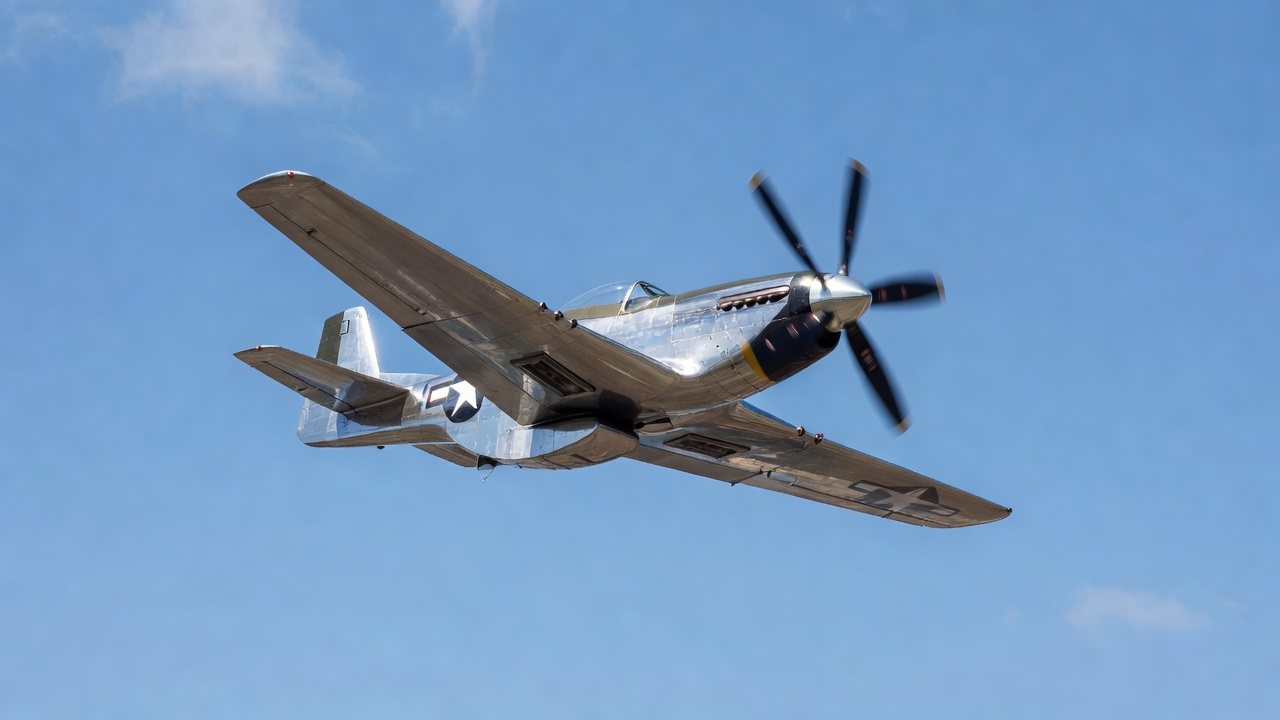
The North American P-51 Mustang stands as one of the most significant engineering triumphs of the mid-20th century. Born from a British Purchasing Commission request in 1940, North American Aviation was initially asked to produce Curtiss P-40s under license. Instead, they proposed an entirely new design, committing to deliver a prototype in an astonishing 120 days. They succeeded, rolling out the NA-73X prototype in 102 days.
Laminar Flow and the Belly Radiator
Two key aerodynamic innovations defined the Mustang's airframe. The first was the adoption of the NACA-developed laminar flow airfoil. By moving the thickest part of the wing further back from the leading edge, designers sought to maintain a smooth, non-turbulent boundary layer of air over a larger percentage of the wing's surface. While true laminar flow was difficult to maintain under field conditions due to dirt and rivet heads, the wing profile nonetheless dramatically reduced drag at high speeds.
The second major innovation was the positioning and design of the cooling system. The Mustang featured a distinctive ventral radiator housing under the rear fuselage. Utilizing the Meredith Effect, the heated air expanding and exiting the radiator duct actually produced a small amount of net thrust, effectively offsetting the aerodynamic drag penalty of the cooling system.
The Packard Merlin Revolution
Despite its aerodynamic brilliance, the early Allison V-1710 powered Mustangs (the P-51A and British Mustang Mk I) suffered from poor high-altitude performance due to the lack of a two-stage supercharger. They were relegated to low-altitude tactical reconnaissance and ground attack roles.
The transformative moment occurred in 1942 when Rolls-Royce test pilots suggested marrying the Mustang airframe with the Rolls-Royce Merlin engine. The result was a revelation. Mass-produced in the United States as the Packard V-1650, this combination birthed the P-51B and P-51C. The addition of a "bubble" canopy to improve rearward visibility resulted in the definitive P-51D, the most widely produced variant.
| Variant | Key Features | Production Count |
|---|---|---|
| P-51A | Allison engine, razorback canopy | 310 |
| P-51B/C | Packard Merlin engine, internal fuselage tank | 3,738 |
| P-51D | Bubble canopy, 6x .50 cal guns, dorsal fin fillet | 8,102 |
Strategic Impact
The USAAF's doctrine of daylight precision bombing over Germany had suffered horrific losses in 1943 during raids on targets like Schweinfurt and Regensburg. Unescorted heavy bombers were highly vulnerable to Luftwaffe interceptors.
The arrival of the P-51B and D variants altered the course of the air war. Fitted with large internal fuel tanks and external drop tanks, the Mustang possessed the unprecedented range to escort bombers all the way to Berlin and back, while retaining the maneuverability and high-altitude speed to defeat German fighters in combat.
Under the command of figures like General Jimmy Doolittle, Mustang pilots were eventually untethered from strict bomber escort duty and authorized to hunt the Luftwaffe aggressively, leading to the rapid attrition of experienced German fighter pilots. The P-51 Mustang remains an enduring symbol of American industrial might and aeronautical innovation.