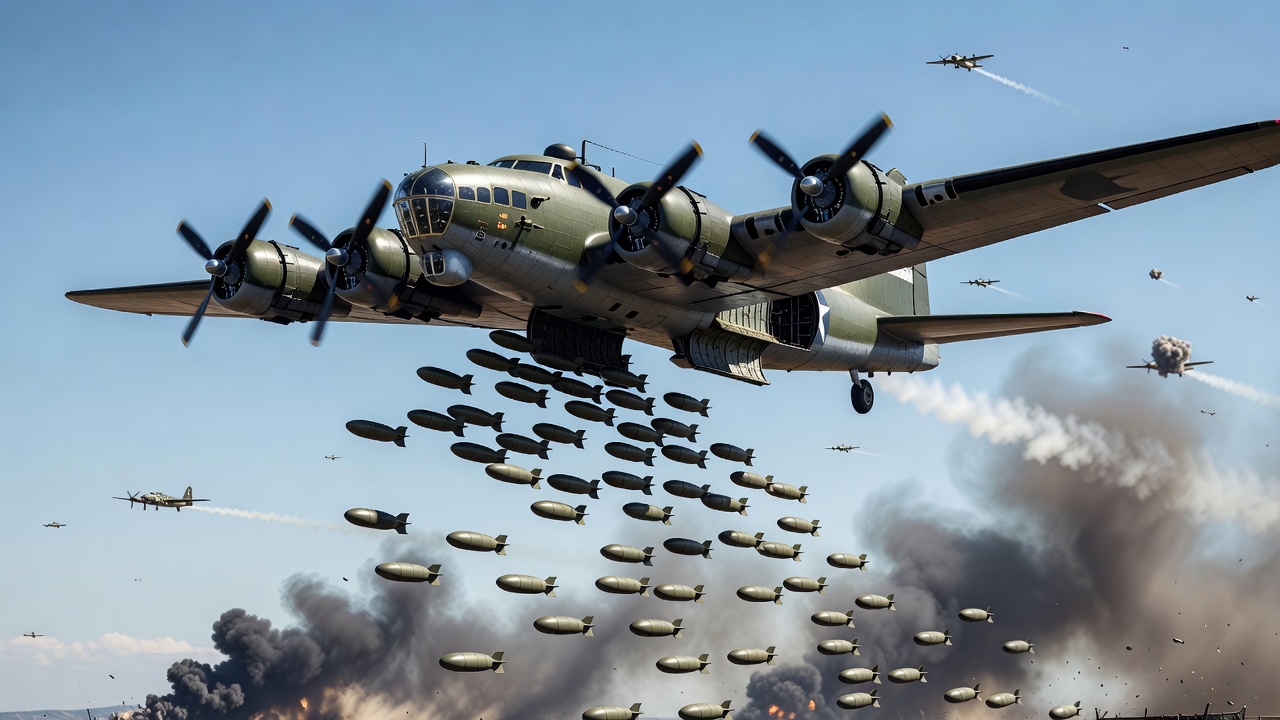
Developed in the 1930s as the Boeing Model 299, the B-17 Flying Fortress became the instrument through which the United States Army Air Forces (USAAF) executed its controversial daylight precision bombing campaign against industrial targets in occupied Europe.
Engineering the Fortress
The B-17 was designed to fly high and defend itself. To achieve the necessary operational altitudes, its four Wright R-1820 Cyclone radial engines were fitted with General Electric turbosuperchargers. This exhaust-driven technology allowed the engines to maintain sea-level power in the thin air above 25,000 feet, giving the B-17 a significant altitude advantage over early interceptors and light flak.
As its name suggests, the aircraft was built around heavy defensive armament. Early models (B-17C/D) proved inadequately armed during RAF trials. By the time of the definitive B-17G model, the aircraft was equipped with thirteen .50 caliber M2 Browning machine guns. These included a chin turret, dorsal turret, ventral ball turret, waist guns, and a tail stinger. The theory was that tightly packed "combat boxes" of mutually defending bombers could fight their way to the target without fighter escort.
| Turret Position | Gun Configuration | Field of Fire |
|---|---|---|
| Chin (B-17G) | Twin .50 cal (Bendix) | Forward hemisphere defense |
| Dorsal | Twin .50 cal (Sperry) | Upper hemisphere |
| Ball (Ventral) | Twin .50 cal (Sperry) | Lower hemisphere |
| Tail | Twin .50 cal | Rear pursuit defense |
The Norden Bombsight
Central to the USAAF doctrine was the Norden bombsight, an early analog computer housed in the nose of the B-17. The bombardier would input altitude, airspeed, and wind drift. During the bomb run, the sight actually took control of the aircraft's autopilot, theoretically allowing for precision drops on specific factories or rail yards. In reality, European cloud cover, combat stress, and the extreme cold at altitude often degraded this accuracy, leading to a de facto shift toward area bombing over heavily defended cities.
Survivability and Mythos
The B-17 is arguably most famous for its structural integrity. It featured a robust, redundant structural design and large, wide-chord wings that generated immense lift even when heavily damaged. Photographic evidence of Fortresses returning to base in England with massive sections of their tails or wings missing—or entirely on fire—solidified its reputation.
However, the unescorted daylight raids of 1943 proved that defensive firepower alone was not enough. Losses were unsustainable until the introduction of long-range escort fighters like the P-51 Mustang. Despite these early strategic miscalculations, the B-17 remains a cornerstone of aviation history, symbolizing the immense sacrifices of the Eighth Air Force.