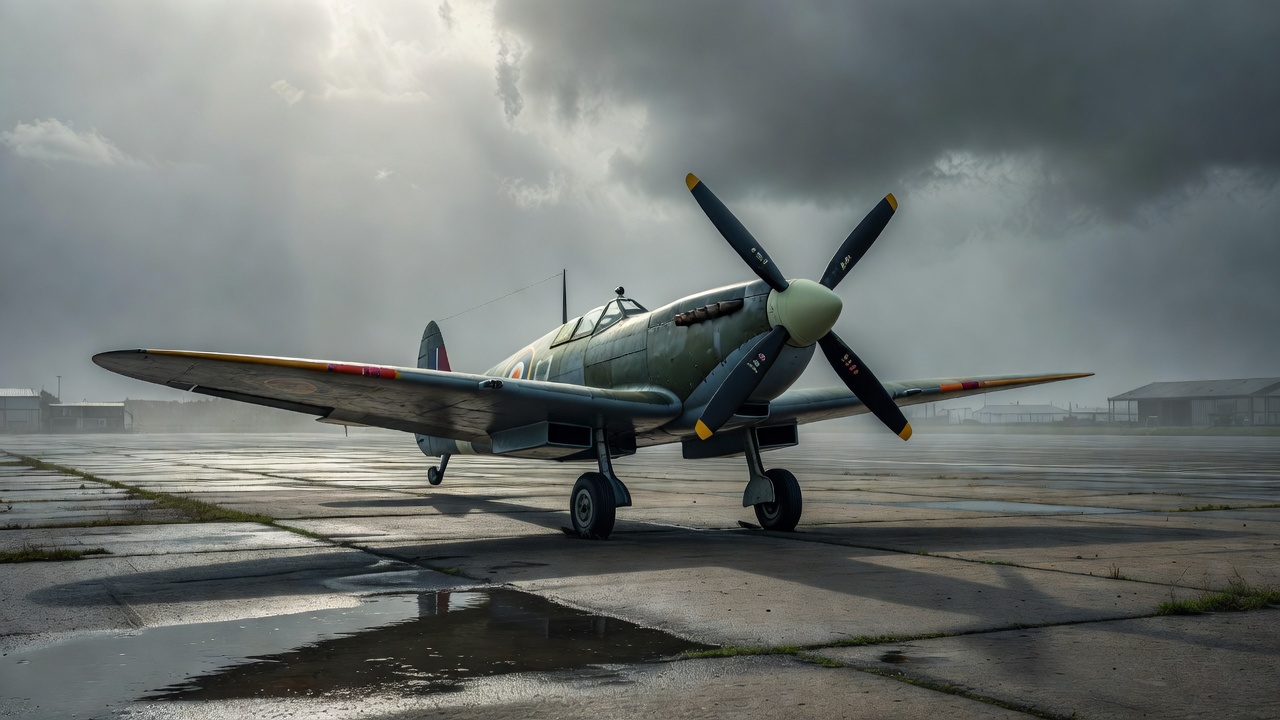
The Supermarine Spitfire is arguably the most famous British aircraft of all time. Designed as a short-range, high-performance interceptor by R.J. Mitchell, chief designer at Supermarine Aviation Works (which operated as a subsidiary of Vickers-Armstrong from 1928), the Spitfire was instrumental in the defense of Britain in 1940 and served in every major theatre of the Second World War.
Design and Aerodynamics
The most visually striking and aerodynamically significant feature of the Spitfire is its elliptical wing. This design was not chosen purely for aesthetic reasons; it was a highly efficient solution to a complex engineering problem. The elliptical planform minimized induced drag, but more crucially, it allowed the wing to be exceptionally thin while still providing enough internal volume to house the undercarriage and armament.
Early marks were fitted with eight .303 Browning machine guns (the 'A' wing). However, as aerial warfare evolved and enemy aircraft became better armored, this was found to be insufficient. The wing was subsequently adapted to carry 20mm Hispano cannon (the 'B', 'C', and 'E' wings), requiring ingenious blister fairings to accommodate the weapon's drum feed mechanisms within the thin airfoil.
Construction relied on an advanced all-metal, stressed-skin duralumin monocoque structure. This made the airframe incredibly strong, though undeniably complex and time-consuming to manufacture compared to its contemporary, the Hawker Hurricane. The flush-riveted skin contributed significantly to the aircraft's top speed.
The Powerplant Evolution
The lifeblood of the Spitfire was the Rolls-Royce Merlin engine, a 27-litre, liquid-cooled V-12. The synergy between Mitchell's airframe and the Merlin engine created a machine of exceptional grace and lethality.
| Variant | Engine Model | Horsepower | Primary Role |
|---|---|---|---|
| Spitfire Mk I | Merlin II / III | 1,030 hp | Day Fighter (BoB) |
| Spitfire Mk V | Merlin 45 | 1,470 hp | Fighter-Bomber |
| Spitfire Mk IX | Merlin 61 (Two-stage) | 1,565 hp | High-Altitude Interceptor |
| Spitfire Mk XIV | Griffon 65 | 2,050 hp | Low/Med Altitude Fighter |
One of the most remarkable aspects of the Spitfire was its capacity for continuous development. The basic airframe proved so fundamentally sound that it could accommodate immense increases in engine power and weight without requiring a total redesign. By 1943, the introduction of the two-stage, two-speed supercharged Merlin 60 series in the Spitfire Mk IX restored parity against the formidable Focke-Wulf Fw 190.
In the later stages of the war, the Merlin was superseded by the massive Rolls-Royce Griffon, a 37-litre engine. Griffon-powered Spitfires, such as the Mk XIV, were noticeably different beasts—heavier, brutally fast, and characterized by a distinctive, deeper engine roar and a five-bladed Rotol propeller.
Operational Legacy
During the Battle of Britain in the summer of 1940, the Spitfire captured the public imagination. While the more numerous Hawker Hurricane carried the brunt of the load against German bomber formations, the Spitfire was tasked with engaging the Messerschmitt Bf 109 escort fighters. Its superior turn radius and excellent high-altitude performance made it a deadly adversary in a dogfight.
Beyond the defense of the UK, the Spitfire operated in the Mediterranean, the Pacific, and the Eastern Front (via Lend-Lease). It took on roles far beyond its original interceptor brief, serving as a fighter-bomber, a photo-reconnaissance platform, and even operating from aircraft carriers as the Seafire.
The Spitfire's enduring legacy is a testament to uncompromised engineering and the industrial mobilization of wartime Britain. It remains a symbol of defiance and aeronautical beauty.