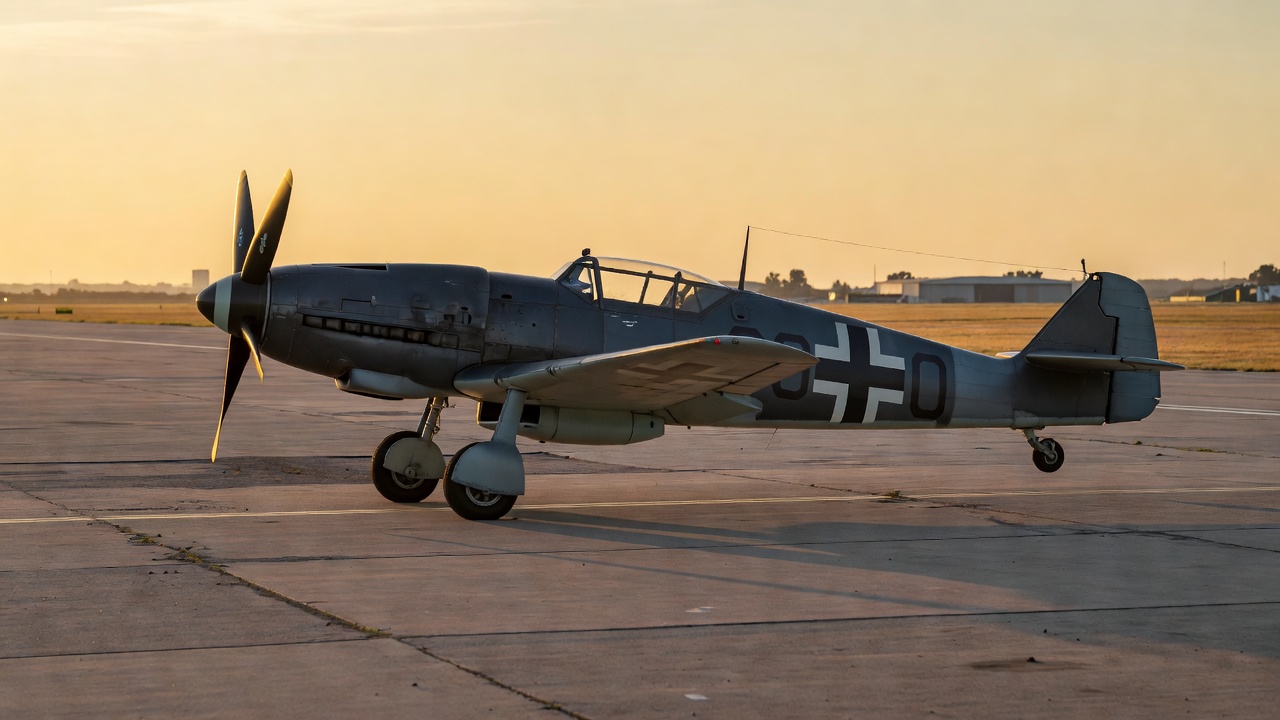
Designed by Willy Messerschmitt and Robert Lusser at Bayerische Flugzeugwerke in the mid-1930s, the Bf 109 was one of the first truly modern fighters of the era, featuring an all-metal monocoque construction, a closed canopy, and retractable landing gear. It became the most produced fighter aircraft in history.
Lightweight Concept and Slats
Messerschmitt’s design philosophy centered on a concept of lightweight construction. The airframe was built as tightly around the pilot and the engine as possible to minimize drag and weight. This resulted in an exceptionally high rate of climb and excellent acceleration.
Because the aircraft had a relatively small wing area to achieve high speeds, it required leading-edge slats to maintain maneuverability at low speeds. These automatic, aerodynamically deployed slats prevented early stall, giving Luftwaffe pilots a crucial advantage in tight, slow-speed turning engagements, though they could snap open asymmetrically and startle inexperienced pilots.
Fuel Injection Advantage
Early marks of the Bf 109, such as the 'E' (Emil) variant used during the Battle of Britain, were powered by the Daimler-Benz DB 601 inverted V-12 engine. A massive tactical advantage of this engine was its use of direct fuel injection rather than a float carburetor.
When an aircraft with a float carburetor (like early Merlin-powered Spitfires and Hurricanes) enters a steep dive, the negative G-forces cause the fuel supply to cut out momentarily, flooding the engine and causing a loss of power. Bf 109 pilots could merely push the stick forward into a vertical dive to escape pursuit, confident their engine would continue running seamlessly.
| Major Variant | Nickname | Key Changes |
|---|---|---|
| Bf 109 E | Emil | Standardized DB 601, primary Battle of Britain fighter. |
| Bf 109 F | Friedrich | Major aerodynamic redesign, rounded wingtips, unbraced tailplane. |
| Bf 109 G | Gustav | Introduction of the DB 605 engine, heavier armament (G-6 'bulges'). |
| Bf 109 K | Kurfürst | Late war standardization attempt, DB 605D with MW 50 boost. |
Operational Shortcomings
While an exceptional dogfighter, the Bf 109 had inherent flaws. Its narrow-track undercarriage, hinged directly to the fuselage rather than the wings, made ground handling notoriously treacherous, leading to thousands of training accidents. Furthermore, the cockpit was severely cramped, and the heavy canopy framing heavily restricted pilot visibility.
Strategically, its lack of range was a critical failure during the Battle of Britain, allowing fighters only 10 to 20 minutes of combat time over London before having to break off and return to France. Despite these flaws, flown by experten, the Bf 109 remained a lethal adversary up until the final days of the war, a masterpiece of austere, ruthless engineering.